


Gas Systems VS Electric Systems
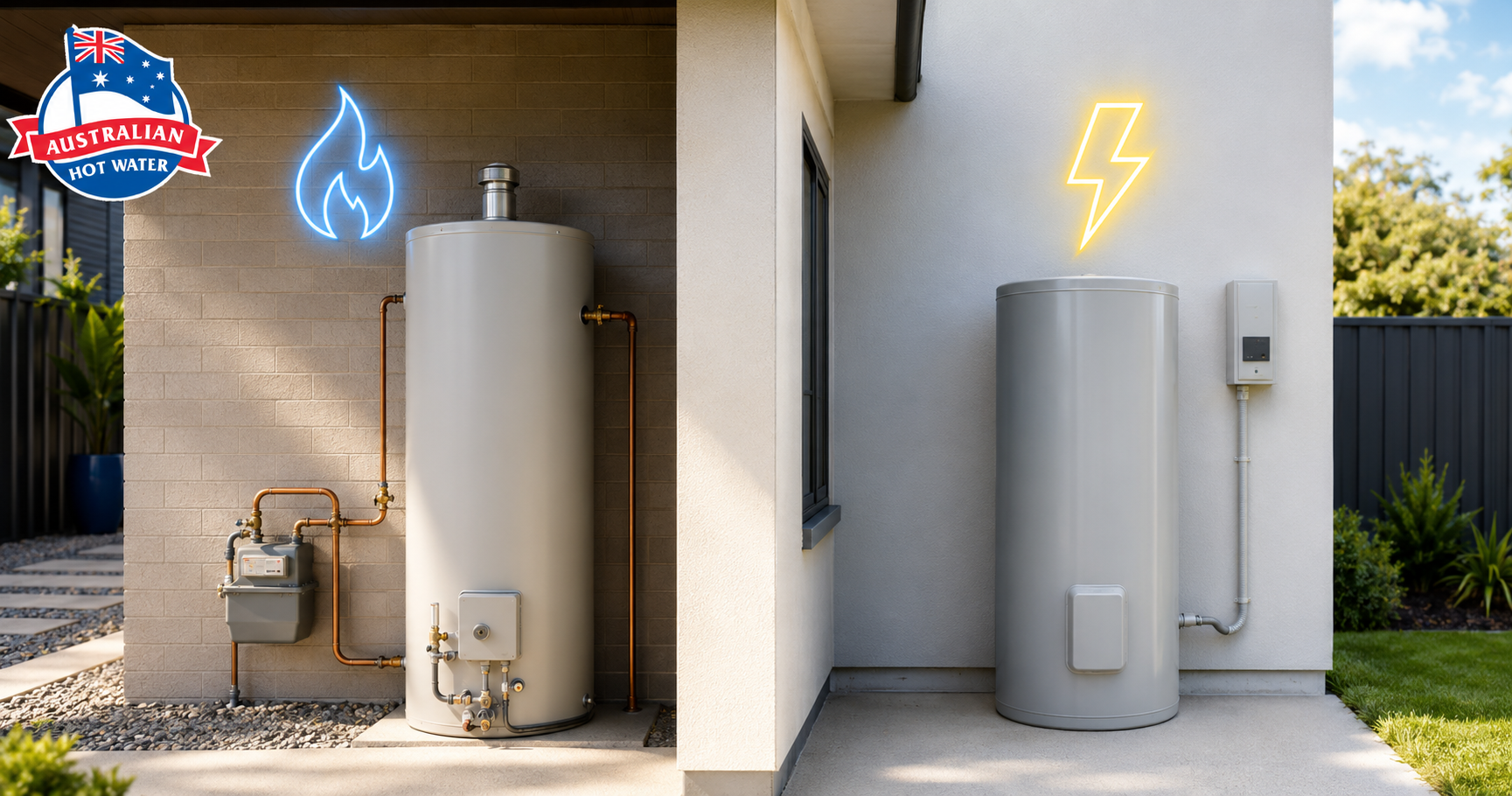
Choosing between gas and electric hot water systems can be a bit of a headache because both options work pretty well as long as you pick the right one for your place. The best system isn’t always the new, top-of-the-line one or the most expensive. It really comes down to how you and your household use hot water on a daily basis.
For example, a couple living in a one-bedroom apartment with one bathroom might be looking for a simple, budget-friendly replacement, while a family in a three-bathroom home might be more concerned with whether the system can handle multiple showers running at the same time. So the right decision all starts with your household’s daily routine, not just what kind of fuel it uses.
This guide breaks down the key differences between gas and electric hot water systems, so you can figure out which one is more likely to suit your home, your budget and your morning rush.
1) Quick answer: Gas or Electric?
If you want the simplest rule of thumb, gas tends to suit homes with higher hot water demand, while electric is usually better for homes that want a straightforward, easy to replace system. However, there are exceptions. A big electric storage tank can work perfectly for a family, while a small gas system might be overkill for a low-use household.
What’s most important is how much hot water you’re using at the same time. Are your showers running back to back? If so, a gas continuous flow system or a larger storage tank might be the way to go. If hot water use is spread out, electric storage could be perfect.
| If your home is like this | Lean toward gas | Lean towards electric |
| Two bathrooms and showers overlap | Yes | Only if you size up significantly |
| One bathroom, one shower at a time | Optional | Yes (often simplest) |
| You already have natural gas connected | Yes | Optional |
| You want the simplest replacement | Sometimes | Often |
| You want the strongest “busy morning” performance | Yes (continuous flow) | Sometimes (larger storage) |
So, gas tends to be the best choice when you need a lot of hot water at once, while electric is usually the way to go when you just want a simple, hassle-free system. Before choosing, think about what’s been driving you crazy about your current system: running out of hot water, high bills, slow recovery, too little space or the cost of replacing it. Your answer will usually point you in the right direction.
2) What you’re really comparing
When people say “gas vs electric”, they’re often comparing a bunch of different systems at the same time. For gas, that might mean a storage tank or a continuous flow system. For electric, it might be a traditional electric storage tank or one of those fancy heat pump systems.
The difference matters because each system behaves in its own way in your home. Some store hot water in a tank, while others heat it as you use it. Some are cheaper and easier to install, while others are better suited to busy households with lots of bathrooms.
| System type | Energy | How it works | What it feels like |
| Gas continuous flow | Gas | Heats water as you use it, with no storage tank | Hot water on demand when sized right |
| Gas storage | Gas | Stores hot water in a tank and reheats faster than electric | Tank buffer plus quicker recovery |
| Electric storage | Electric | Stores hot water in a tank and reheats over time | Simple and common, but depends on reheating |
| Heat pump | Electric | Efficiently heats a storage tank using heat from the air | Lower running costs, steady recovery |
A gas continuous flow system can feel like night and day compared to a gas storage system. And a heat pump can be a lot different than a standard electric tank. So rather than asking “gas or electric?”, it’s better to ask: “Do I want hot water stored ready to go, or do I want it heated on demand?” That makes the choice a heck of a lot easier.
3) The biggest deciding factor: peak demand
Peak demand is the bit that many homeowners tend to overlook. It’s the busiest time of day for hot water use, usually the morning rush when one person’s in the shower, someone else is turning on the tap, and another person’s about to use the second bathroom.
A system that works fine for one shower at a time might struggle when two showers go on at the same time. That’s why two households with the same number of people can need different systems. Bathroom count, shower habits and whether you’ve got overlapping use are all important factors that can matter more than the number of people in the household.
| What can run at the same time | Typical demand |
| Standard shower | 8–12 L/min |
| High-flow / rainfall shower | 12–16 L/min |
| Kitchen tap | 6–8 L/min |
| Bathroom basin | 4–6 L/min |
If your current system runs out or the temperature drops during the morning rush, it’s not necessarily a gas vs electric problem. It might just be a peak demand problem. Choosing the right size and type of system for that busy window is what makes hot water feel reliable.
4) Reliability: what tends to go wrong and why
When people say their hot water system is “unreliable”, they usually mean one of a few things: it runs out, the temperature changes, it takes too long to recover, or bills feel too high. These problems can happen with either gas or electric systems if the system isn’t matched to the home.
The good news is that most reliability issues are predictable. They usually come down to sizing, system type, how well it was installed, and how the household uses hot water. That means they can usually be avoided by making the right choice upfront.
| What you notice at home | More common with | Usually caused by |
| “We run out of hot water” | Storage systems, gas or electric | Tank too small, reheating schedule, overlap |
| “Second shower changes temperature” | Continuous flow, when undersized | Output too low for simultaneous demand |
| “It’s fine most days, but not on busy mornings” | Any type | System not sized for peak demand |
| “Bills are higher than expected” | Often electric storage | Tariff mismatch, older unit, high usage |
Gas doesn’t automatically mean more reliable, and electric doesn’t automatically mean you’ll run out. A well-sized electric system can be very dependable. An undersized gas continuous flow unit can still let you down. Reliability comes from matching the system to the household, not just choosing a particular fuel type.
5) Cost and practicality – are these really the deciding factors?
Cost is a huge factor, but you can’t just use the up front price as a guide. You gotta think about the full story: what you pay for the system, how much the installation is going to set you back, whether you’ve already got gas on tap, whether you’ll need to rip out your current plumbing and how easy it is to get to where you need to be to do the installation.
In some cases it might be no big deal to swap out a like-for-like electric storage system for a new one. But if you’re looking to ditch electric storage for gas continuous flow you might be looking at a more involved job. And on the other hand if you’ve already got gas on tap and you want to go for something that’ll save you some space, then gas continuous flow might still be a good long term option.
Why quotes and final costs vary
| Factor | Why it matters |
| Like-for-like swap vs upgrades | Changes labour, parts and compliance work |
| Tank vs continuous flow | Continuous flow can require additional plumbing or gas work |
| Gas supply / pipe sizing | Upgrades may be required for higher-output units |
| Access and location | Tight installs can increase labour |
| Warranty level / model tier | Longer warranties and premium models cost more |
Practical installation differences
| Consideration | Gas | Electric |
| Needs gas connection | Yes | No |
| Compact option available | Yes, continuous flow | Less often, usually a tank |
| Like-for-like replacement simplicity | Sometimes | Often easiest |
| Good for limited space | Continuous flow often wins | Smaller tanks only |
When comparing costs, what really helps is to think about the whole picture: what you paid for the system, how much to install it, what it’s actually going to cost you to run it and how well it’s going to work with your household needs. A system that comes in cheap but can’t keep up with your household might not feel like such a bargain in the end. A slightly more considered purchase might end up saving you a lot of headache down the line.
The key to it all is matching the system to your household’s hot water habits. Think about what time of day gets the most use, how many showers can run at once, whether you’ve already got gas sorted and whether you prefer a storage tank or continuous flow system.
Once you’ve got all that sorted out then the choice really isn’t that hard.